Children learn when they are curious and involved. Learning through play turns everyday moments into opportunities to build language, early maths, memory, observation, pronunciation and problem-solving skills. Parents can use household objects and digital activities to make learning enjoyable.
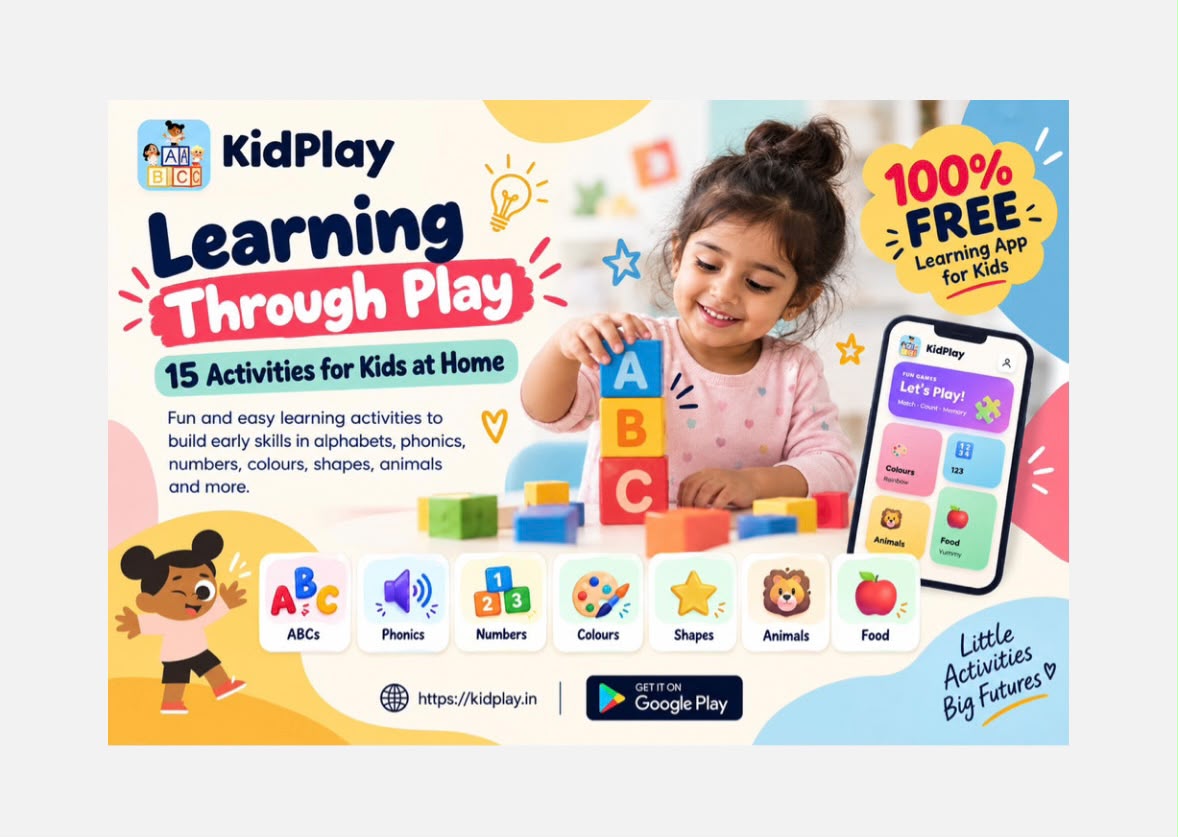
Kid Play supports playful early learning with interactive activities, bright illustrations and voice pronunciation. It includes Alphabet, Numbers, Colours, Shapes, Phonics, Animals, Vehicles, Food, Body Parts, Family, Opposites, and Days & Months.
15 Learning Through Play Activities
1. Alphabet Hunt — Age 2–4
Choose a letter and ask your child to find objects beginning with its sound. Reinforce uppercase and lowercase recognition with Kid Play’s Alphabet section.
2. Count and Group — Age 3–5
Use toys or blocks for counting and grouping. Ask which group has more. Kid Play’s Numbers section supports number recognition and counting from 1 to 100.
3. Colour Sorting — Age 2–4
Collect safe objects and sort them by colour. Name each colour together, then practise identification with Kid Play’s Colours activities.
4. Shape Detective — Age 3–5
Find circles, squares, rectangles, triangles and stars around your home. Practise shape recognition in Kid Play’s Shapes section.
5. Phonics Practice — Age 3–6
Say a letter sound and let your child repeat it. Connect the sound with a familiar word. Kid Play’s Phonics content and voice pronunciation support early reading.
6. Animal Guessing — Age 2–5
Give clues such as “I have four legs and say meow.” Kid Play’s Animals section introduces domestic and wild animals, names and sounds.
7. Vehicle Spotting — Age 2–5
During a walk or car ride, identify cars, buses, trains, boats and airplanes. Reinforce vocabulary with Kid Play’s Vehicles category.
8. Food Sorting — Age 2–5
Sort pretend or pictured foods into fruits, vegetables and snacks. Kid Play’s Food activities introduce familiar foods and vocabulary.
9. Body Parts Simon Says — Age 2–4
Play “Simon Says: touch your nose” or “touch your knees.” This builds listening. Use Kid Play’s Body Parts content for visual reinforcement.
10. Family Picture Talk — Age 3–6
Look at a family photo and name parents, grandparents and siblings. Kid Play’s Family section introduces family members and relationships.
11. Opposites Challenge — Age 3–6
Teach big/small, hot/cold, fast/slow and day/night. Demonstrate each pair and reinforce them in Kid Play’s Opposites section.
12. Calendar Game — Age 4–7
Ask what day comes before or after today. Practise weekdays and months with a calendar and Kid Play’s Days & Months learning area.
13. Memory Match — Age 3–6
Place five objects on a table, cover them and remove one. Ask what is missing. Repeat with letters, colours, animals or numbers.
14. Picture Storytelling — Age 3–7
Choose a picture of an animal, vehicle, food or family member and ask your child to create a short story. This builds vocabulary.
15. Match, Count and Remember — Age 3–7
Create a challenge involving matching, counting and memory. Kid Play’s interactive “Match • Count • Memory” games can extend this practice.
Why Learning Through Play Matters
Play lets children explore, repeat, make mistakes and try again. It can support early literacy, numeracy, communication, concentration, recognition and confidence. Short activities can be easier to sustain than long lessons.
Kid Play is a child-friendly learning experience where children participate instead of simply watching videos. Bright illustrations keep learners engaged, while clear audio supports pronunciation. It supports foundational learning before school with no subscription fees.
Ready to add playful learning to your child’s routine? Download Kid Play on Google Play or visit the official Kid Play website. It is a 100 percent free app for early learning.
Frequently Asked Questions
What age is Kid Play suitable for?
Kid Play supports foundational learning for children, particularly preschool and early learners.
What can children learn with Kid Play?
Children can explore alphabet, numbers, colours, shapes, phonics, animals, vehicles, food, body parts, family, opposites, and days and months.
How does learning through play help children?
It makes learning active and enjoyable while encouraging repetition, recognition, communication, memory and problem-solving.
Is Kid Play free?
Yes. Kid Play can be downloaded and used without subscription fees.
Can parents combine Kid Play with home activities?
Yes. Hands-on games, reading, conversation and digital activities can create a learning routine.
Learning does not have to feel like a formal lesson. A colour hunt, counting game, animal quiz, phonics activity or calendar challenge can turn time at home into learning. Combining these activities with Kid Play encourages children to learn through exploration and play.
Download Kid Play now on Google Play and explore Kid Play for information.