Circle, Square, Triangle: Easy Shape Learning for Kids
Learning basic shapes is an important part of early childhood education. Circle, square, and triangle are among the first shapes children can recognize, name, draw, and find in their surroundings. Shape learning helps children build visual awareness while preparing them for early mathematics, drawing, patterns, puzzles, and other classroom activities. The best way to teach shapes to preschoolers is to connect learning with familiar objects and playful activities.
A circle is round and has no corners or straight sides. Children can identify circles in balls, plates, wheels, clocks, coins, buttons, and many other everyday objects. A square has four equal sides and four corners. Windows, tiles, boxes, cushions, and picture frames can provide simple examples. A triangle has three sides and three corners. Children may notice triangles in road signs, rooftops, pizza slices, flags, and musical instruments. Showing children real examples helps them understand shapes instead of simply memorizing their names.
Easy Ways to Teach Shapes to Preschoolers
Parents and teachers can introduce shape learning using objects already available at home or in the classroom. Start by showing a circle, square, and triangle and clearly saying each name. Then ask children to look around and find objects that have a similar shape. A simple question such as, “Can you find something shaped like a circle?” turns everyday surroundings into a learning activity.
Drawing and tracing are also effective ways to practise shapes. Draw large circles, squares, and triangles on paper and allow children to trace them with their fingers, pencils, or crayons. Encourage children to draw the shapes independently after tracing. Colouring the shapes can make the activity more enjoyable while also supporting hand control and fine motor development.
Another useful activity is shape sorting. Collect objects or picture cards representing different shapes and ask children to place them into groups. For example, round objects can go into the circle group, while objects with four equal sides can go into the square group. Matching activities can also help children connect a shape with a familiar object, such as matching a ball with a circle or a window with a square.
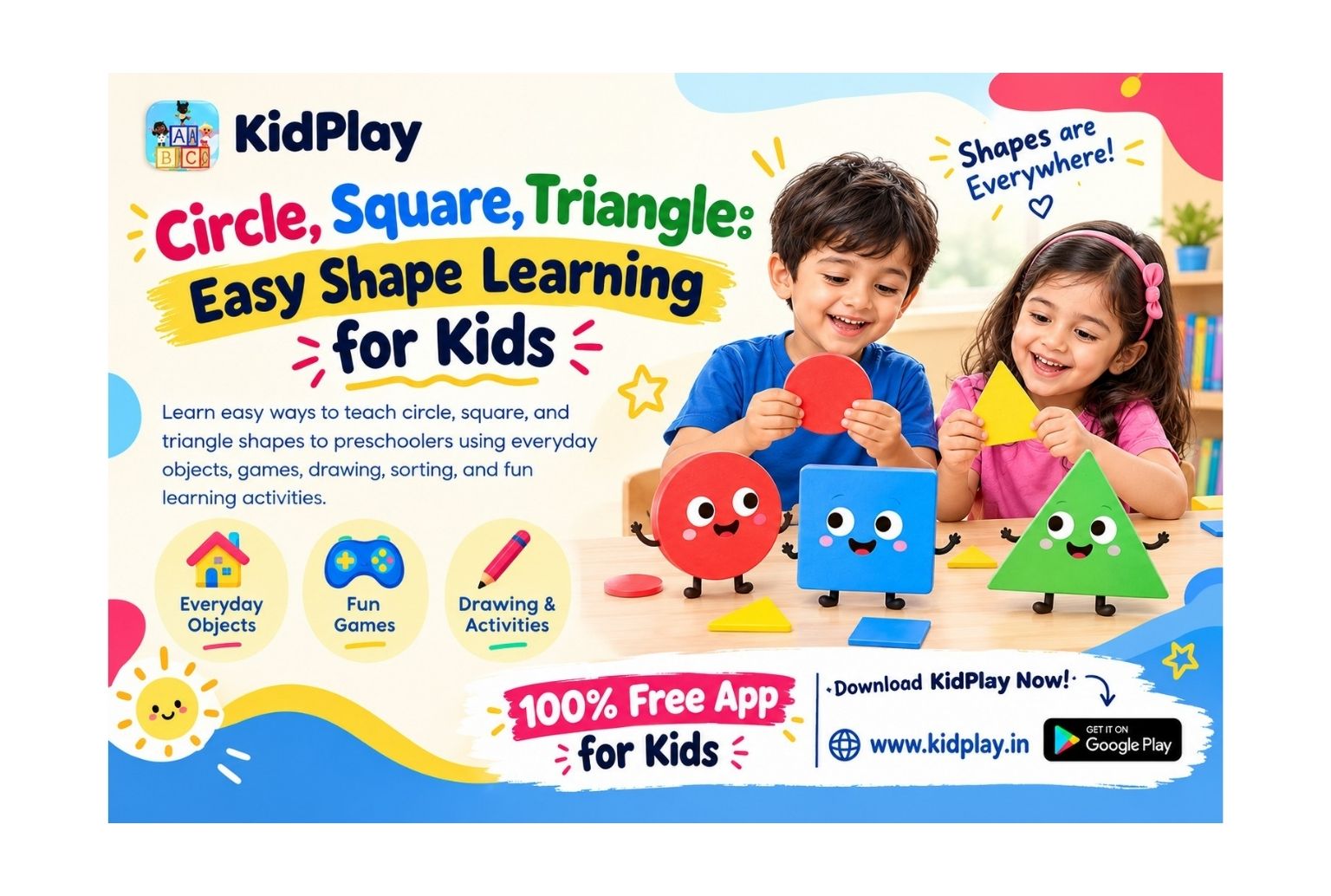
Looking for more interactive ways to support early learning? Explore KidPlay or download the 100 percent free KidPlay app on Google Play for additional activities for young children.
Why Shape Recognition Matters
Learning shapes supports several important early childhood skills. When children compare a circle, square, and triangle, they practise observation, concentration, memory, and visual discrimination. They begin to notice differences such as straight lines, curved lines, sides, corners, size, and position. These skills can later support early mathematics, handwriting, drawing, puzzles, and pattern recognition.
Shape activities can also encourage language development. Parents can introduce words such as round, side, corner, straight, curved, big, small, same, and different while discussing shapes. Asking children to describe what they see encourages them to communicate their observations and gradually develop a stronger vocabulary.
Shape learning can also support creativity. Once children recognize basic shapes, encourage them to combine them to create pictures. A circle can become the sun or a face, a square can become a window or building, and triangles can become rooftops, trees, or mountains. This approach connects early learning with imagination and art.
Fun Shape Games for Kids
Shape learning becomes more effective when children can participate rather than simply listen. A shape hunt is one easy game that can be played at home, in school, or outdoors. Give children one shape at a time and ask them to find as many examples as possible. For younger children, start with circles and squares before introducing triangles and other shapes.
A shape drawing challenge is another simple activity. Ask children to create a picture using only circles, squares, and triangles. They might draw a house using a square and triangle, a person using circles and other simple shapes, or a vehicle using circles for wheels and rectangles for the body. This activity helps children recognize shapes while encouraging creativity.
Parents can also use movement-based games. Draw large shapes on the floor and ask children to stand inside the circle, jump onto the square, or walk around the triangle. Combining movement with visual learning can make practice more engaging and memorable.
Moving Beyond Circle, Square, and Triangle
Once children confidently recognize these three basic shapes, parents can gradually introduce rectangles, ovals, stars, hearts, diamonds, and other familiar shapes. It is helpful to introduce new shapes slowly rather than presenting too many at once.
Children can also compare shapes. Ask questions such as, “Which shape has three corners?” or “Which shape is round?” These questions encourage children to think about characteristics rather than only remembering names. Later, parents can introduce simple patterns, such as circle-square-circle-square, to connect shape recognition with early logical thinking.
Digital learning can complement hands-on activities when used appropriately. Interactive activities allow children to see, identify, match, and practise concepts repeatedly. Early-learning resources can also introduce children to related topics such as alphabets, phonics, numbers, colours, animals, vehicles, food, body parts, family, opposites, and days and months.
Frequently Asked Questions
What are the three basic shapes children should learn first?
Circle, square, and triangle are commonly introduced as foundational shapes because children can easily find examples of them in everyday surroundings.
How can I teach shapes to a preschooler at home?
Use everyday objects, shape hunts, tracing, colouring, sorting, matching, drawing, and simple movement games to make shape learning practical and enjoyable.
Why should preschoolers learn shapes?
Shape recognition develops observation, visual discrimination, concentration, vocabulary, fine motor skills, and early mathematical thinking.
How can I make shape learning more interesting?
Connect shapes with real objects and creative activities. Ask children to find shapes around the house, create pictures using basic shapes, or play simple shape-matching and sorting games.
When should children start learning shapes?
Children can begin exploring basic shapes during the preschool years through simple, age-appropriate activities. Learning should focus on recognition and enjoyment rather than memorizing formal definitions.
Conclusion
Circle, square, and triangle learning can be simple, engaging, and meaningful when children experience shapes through everyday objects and play. Drawing, tracing, sorting, matching, shape hunts, movement games, and creative activities give preschoolers repeated opportunities to recognize and understand basic shapes. With regular practice and encouragement, children can develop stronger visual awareness and early mathematical skills while enjoying the learning process.
Ready to make early learning more interactive? Visit KidPlay to explore activities for preschool and kindergarten children, or download the 100 percent free KidPlay app on Google Play.