A to Z learning becomes enjoyable when letters, sounds, numbers, colours, and shapes are taught through play.
Children learn through seeing, hearing, matching, and repeating. Parents can combine home activities with KidPlay.
A – Alphabet Hunt: Find objects beginning with a chosen letter and say each word aloud. KidPlay supports ABC learning with letters, pictures, and pronunciation.
B – Beginning Sounds: Say a letter sound and ask children to identify a matching picture. Repeat sounds regularly.
C – Counting Fun: Count toys, blocks, fruits, or objects. Ask, “How many?” KidPlay supports number recognition and counting.
D – Drawing: Draw letters, shapes, animals, or anything your child imagines. Trace large letters with crayons, sand, or fingers.
E – Everyday Vocabulary: Name objects such as books, cups, doors, and spoons. Add words like big, small, red, and round.
F – Find and Match: Match letters, colours, shapes, pictures, or objects. Matching develops recognition and observation.
G – Memory Game: Show several objects, hide one, and ask what is missing.
H – Healthy Food Learning: Identify fruits and vegetables, their colours, and names.
I – Identify Shapes: Teach circles, squares, triangles, rectangles, and stars. Find these shapes around the home.
J – Join the Dots: Use simple dot-to-dot letters, numbers, and shapes to support sequencing and pencil control.
K – Know Animals: Identify animals and imitate their sounds. KidPlay includes animal names and sounds for vocabulary learning.
L – Letter Matching: Match uppercase and lowercase cards such as A-a, B-b, and C-c.
M – Months and Days: Introduce weekdays and months with songs, calendars, and talks.
N – Number Games: Compare two groups and ask which has more or fewer.
O – Opposites: Teach big-small, hot-cold, fast-slow, and day-night using pictures, actions, and objects.
P – Picture Storytelling: Give children a few pictures and ask them to create a story. This supports vocabulary, imagination, and sequencing.
Q – Question Time: Ask questions about colours and shapes to encourage observation.
R – Rhymes and Repetition: Sing alphabet and counting rhymes. Repetition supports memory.
S – Sort and Classify: Sort objects by colour, size, shape, or type.
T – Trace Letters and Numbers: Use large letters and numbers.
U – Understand Vehicles: Name cars, buses, trains, boats, and airplanes. Ask where each vehicle travels. KidPlay includes vehicle learning.
V – Vocabulary Review: Review five new words daily and ask children to identify or use them in a sentence.
W – What Comes Next?: Create patterns such as red-blue-red-blue. Ask children to predict the next item.
X – Xylophone Learning: Use a toy xylophone or tapping game. Ask children to copy a short rhythm to practise listening.
Y – Yes or No: Make simple statements such as, “A banana is yellow.” Children answer yes or no.
Z – Zoom into Review: End with an A to Z review using letters, numbers, colours, shapes, or animals.
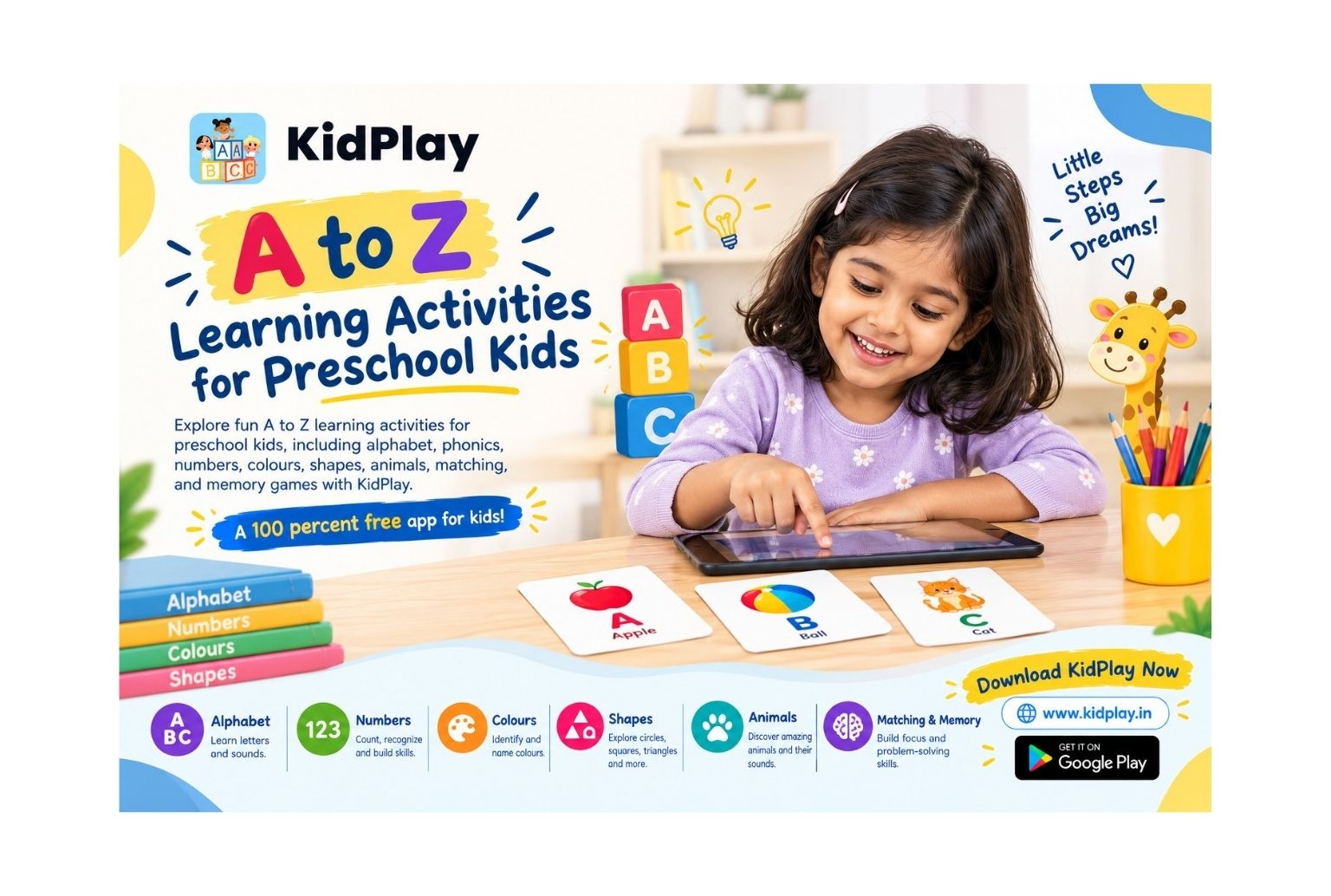
KidPlay brings many preschool learning concepts together in one experience. It includes alphabet, phonics, numbers, colours, shapes, animals, vehicles, food, body parts, family, opposites, days and months, plus mini games for matching, memory, patterns, and finding activities.
KidPlay is suitable for ages 2–8 and offers interactive learning and voice pronunciation.
For parents searching for a 100 percent free app for kids, KidPlay provides a way to add educational play to daily routines.
Children can practise ABC learning, phonics, counting, colours, shapes, vocabulary, memory, and observation with bright visuals.
Download KidPlay now and make learning part of playtime.
Visit the KidPlay website or download the KidPlay 100 percent free app from Google Play.
FAQ
Is KidPlay a 100 percent free app?
Yes. KidPlay is free to download and use, with learning activities and games available without subscription fees.
What can preschool kids learn with KidPlay?
Children can practise alphabets, phonics, numbers, colours, shapes, animals, vehicles, food, body parts, family, opposites, days, and months.
What age is KidPlay suitable for?
KidPlay is designed for young learners aged 2–8 years, including preschoolers and kindergarten learners.
Can parents use KidPlay for home learning?
Yes. Parents can combine KidPlay with reading, drawing, counting, matching, storytelling, and everyday conversations.
Start your child’s A to Z journey with playful practice. Explore the KidPlay website and download the 100 percent free app from Google Play today. Turn everyday screen time into learning time.